
Redefining Insurance Leadership: The Strategic Mindset of Mr. Shammi Kapoor
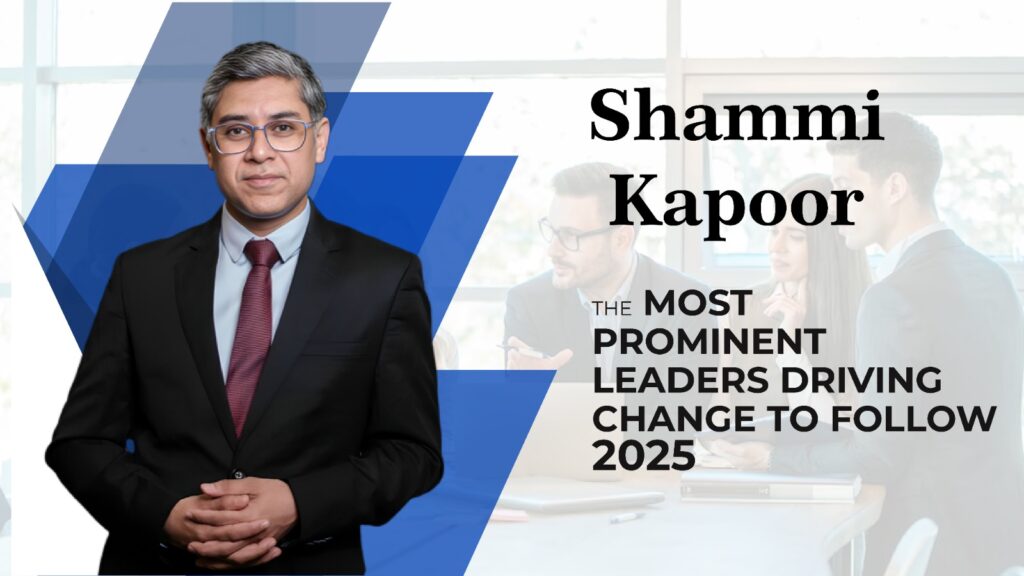
Redefining Insurance Leadership: The Strategic Mindset of Mr. Shammi Kapoor
SVP & Head – Operations, CS & Health Claims
In today’s rapidly changing financial services landscape—especially within insurance—leaders face an extraordinary dual challenge: to innovate relentlessly while safeguarding trust and staying deeply empathetic to evolving customer needs. These demands call for a redefinition of leadership itself, one that transcends operational metrics and unites strategic clarity, technological agility, and cultural intelligence.
Among contemporary visionaries, Mr. Shammi Kapoor stands out as a dynamic force driving this transformation within India’s insurance sector. His nearly two-decade-long journey—spanning Life, Health, and General insurance—reflects the profound evolution of insurance, from a protected risk transfer mechanism to a cornerstone of financial well-being and resilience for millions.
This article explores Mr. Kapoor’s leadership philosophy and how it embodies the multidimensional demands reshaping the insurance ecosystem today.
From Risk Transfer to Customer-Centric Partnership: A Transformational Trajectory
Mr. Kapoor’s career exemplifies a rare, comprehensive grasp of insurance’s multifaceted nature. Starting in traditional risk-transfer roles, he witnessed firsthand the sector’s paradigm shift toward customer-centricity, especially as India’s socio-economic landscape and digitization rates rapidly evolved.
His insights reveal the segmentation of insurance’s modern role:
- Life insurance now extends beyond death benefits into long-term financial planning, legacy building, and protection against life’s uncertainties.
- Health insurance has shifted to emphasize comprehensive health security, crisis management, and wellness, underscoring the increasing intersection with public health infrastructure and technologies like the ABHA platform.
- General insurance protects everyday assets, enabling economic stability and lifestyle continuity despite escalating environmental and societal risks.
Mr. Kapoor articulates how this shift—from product selling to solution designing—demands integrated strategies tailored to distinct customer journeys across urban and Bharat 2.0 markets. The infusion of innovative digital layers—enabled by over 600 million new internet users in India’s emerging regions—is positioning technology not as a mere enabler but as a democratizing force that personalizes and expands insurance’s reach.
Integrating Operations, Customer Service & Health Claims: A Strategic Nexus
The complexity of simultaneously managing operations, customer service, and health claims in insurance is formidable. Historically siloed, these functions under Mr. Kapoor’s leadership form a symbiotic triad where strategic intelligence and shared accountability drive performance.
He champions a leadership culture based on “freedom with responsibility,” empowering teams through:
- Ownership aligned with clear outcomes,
- Cross-domain learning facilitating agile problem-solving,
- Encouragement to challenge legacy processes,
- A foundation of continuous listening and feedback.
This integrative mindset creates ripple effects—operational bottlenecks are preemptively identified, cost efficiency improves, and customer satisfaction, measured through NPS, tangibly rises. Notably, these teams leverage real-time data and operational agility to quickly adapt to market shifts, thus redefining operational excellence as inseparable from customer advocacy.
- How one can ensure excellence in customer service in a highly competitive market?
Customer excellence is not a function—it is a discipline grounded in five core components: Clarity, Influence, Adaptation, Foresight, and Execution. Each plays a pivotal role in shaping meaningful experiences and building long-term trust.
- Clarity: Grasping the Present
Customer excellence begins with a clear understanding of the current landscape. This means recognising the operational nuances, process gaps, and friction points that erode trust and loyalty. Applying the 80:20 principle helps teams prioritise high-impact areas and accelerate transformation. A structured approach—starting with the existing process map, validating it against real-world adherence, identifying deviations, integrating technology for accuracy and agility, and applying strong governance—ensures that improvements are both grounded and sustainable. Influence: Orchestrating Change Through Stakeholders
Customer journeys with frequent interaction points are powerful levers for improvement. Identifying clear SPOCs and empowering them as process custodians creates accountability and ensures that customer feedback is translated into meaningful change. This influence-driven model enhances ownership and leads to consistently higher customer satisfaction.
- Adaptation: Making Customer Service a Philosophy
Customer service is not a department—it is a philosophy that every employee must embody. When teams collectively adopt this mindset, the organization gains the flexibility and empathy required to serve customers seamlessly, irrespective of changing market dynamics. - Foresight: Using Data as a Strategic Compass
Data often remains an underutilized asset in customer experience planning. Embedding the PDCA (Plan–Do–Check–Act) model ensures that trends, patterns, and insights are not only analysed but also converted into actionable improvements. This data-led foresight enables better decision-making, especially in uncertain or rapidly evolving scenarios. - Execution: Bringing Strategy to Life
The integration of these pillars achieves its full potential when paired with a structured execution framework. The AIDA model—Awareness, Interest, Decision, and Action—provides a clear pathway to move insights into action, ensuring that improvements are communicated, embraced, and delivered consistently.
Together, these five components create a robust, future-ready approach to customer excellence—one that elevates experiences, strengthens engagement, and builds enduring competitive advantage.
- What major changes have you seen in health claims management over the years?
The current healthcare ecosystem has witnessed some dramatic changes post-pandemic. We see health insurance picking the importance and relevance from consumer point and The “𝒎𝒐𝒎𝒆𝒏𝒕 𝒐𝒇 𝒕𝒓𝒖𝒕𝒉” is 𝒕𝒉𝒆 𝒊𝒏𝒔𝒖𝒓𝒂𝒏𝒄𝒆 𝒄𝒍𝒂𝒊𝒎. Hence focus has to be in creating a seamless, empathetic experience for customers during their most vulnerable moments. Look 𝗵𝗼𝘄 𝘁𝗲𝗰𝗵𝗻𝗼𝗹𝗼𝗴𝘆 𝗮𝗰𝘁𝘀 𝗮𝘀 𝗮 𝗯𝗿𝗶𝗱𝗴𝗲, enabling faster fraud detection and smoother processes through avenues like ABHA, NHCX, etc., while emphasizing that 𝘁𝗵𝗲 𝗵𝘂𝗺𝗮𝗻 𝘁𝗼𝘂𝗰𝗵 𝗿𝗲𝗺𝗮𝗶𝗻𝘀 𝗶𝗿𝗿𝗲𝗽𝗹𝗮𝗰𝗲𝗮𝗯𝗹𝗲. Some key metrics for claims excellence — 𝘧𝘪𝘳𝘴𝘵-𝘵𝘪𝘮𝘦 𝘳𝘪𝘨𝘩𝘵, 𝘴𝘱𝘦𝘦𝘥 𝘸𝘪𝘵𝘩 𝘢𝘤𝘤𝘶𝘳𝘢𝘤𝘺, 𝘢𝘯𝘥 𝘕𝘗𝘚, to summarize:
- The Power of Simplicity: Communicating in a language the customer understands is the foundation of trust and clarity.
- Technology as a Bridge: While tech accelerates access and connects customers to insurers faster, human guidance remains irreplaceable in building confidence.
- Essential Metrics: True success in claims operations comes down to three factors—first-time right, speed with accuracy, and Net Promoter Score (NPS)
- The Future with AI: AI will not only enhance cost efficiency but also strengthen fraud prediction before it occurs.
Customer Service Excellence as a Discipline: The Five-Pillar Framework
Mr. Kapoor’s articulation of customer service transcends transactional interactions and posits it as a discipline grounded in a structured framework:
- Clarity: A rigorous dissection of operational realities, pain points, and technology integration possibilities prevents assumption-based decisions.
- Influence: Designating singular points of contact (SPOCs) institutionalizes accountability beyond personality-driven efforts.
- Adaptation: Embedding customer-centricity into culture ensures it permeates roles across the organization.
- Foresight: Data-driven PDCA cycles (Plan-Do-Check-Act) support informed, iterative improvements.
- Execution: The AIDA (Attention-Interest-Desire-Action) paradigm translates insights swiftly into impactful interventions.
This framework positions customer service not as a reactive function, but as a proactive, evolving system—ready for scalability and enhanced emotional intelligence.
Health Claims: Balancing Technology and Human Empathy at the Moment of Truth
The claim settlement phase is the insurance “moment of truth,” where promises meet real-life circumstances. Post-pandemic, this domain has seen an acceleration in digitization via national initiatives like ABHA and NHCX, coupled with AI-driven fraud detection and data-enriched medical evaluation.
Yet, Mr. Kapoor emphasizes the indispensable role of empathetic human engagement alongside these technologies. Claims excellence—quantified by metrics like First-Time-Right efficiency, speed balanced with accuracy, and NPS as trust gauges—depends on this blended approach.
He forecasts future AI applications that will advance fraud detection preemptively, reshaping claims from reactive processes into proactive risk shields.
Digital Transformation: Shaping Insurance’s Social and Technological Fabric
The wave of digital innovation sweeping India’s insurance sector is not purely technological—it is profoundly social. Technologies like robotic process automation, AI-enhanced KYC, WhatsApp-enabled service delivery, and cloud scalability interweave with shifting customer identities in Bharat 2.0.
Here, traditional consumer roles blur into creators and community influencers, reshaping trust networks. Digital transformation must thus be viewed as a reimagining of customer experience, integrating hyperlocal nuances and micro-influencer dynamics rather than just process digitalization.
Mr. Kapoor highlights that embracing this social-technical shift is now the insurance industry’s key competitive frontier.
People, Culture, and Leadership: Building Resilient, Emotionally Intelligent Teams
Leadership transcends technical skill alone. Adopting thought frameworks inspired by human-centric theorists like Timothy Timur Tiryaki, Mr. Kapoor spearheads a multi-dimensional people strategy comprising:
- Shared purpose-driven vision linking meaning with performance,
- Strategic talent alignment ensuring capability-responsibility fit,
- Employee value propositions fostering growth, balance, and dignity,
- Culture action plans manifesting feedback into measurable change,
- Coaching leaders as culture bearers who model desired behaviours.
This holistic approach nurtures teams agile enough to navigate insurance’s evolving challenges while sustaining emotional resilience and motivation.
Navigating the Regulatory Landscape: Compliance as a Trust Enabler
Given insurance’s regulated nature, innovation often grapples with compliance constraints. Mr. Kapoor’s perspective reframes regulation from a hurdle to a design parameter. Employing automated rule engines, embedded audit trails, integrated risk management, and continuous training fosters trust and security.
The outcome: compliance evolves into a proactive brand differentiator, embedding ethical data use and transparency at every operational layer.
Analytics: The Strategic Nerve Center of Claims Management
Data analytics now underpins insurance decision-making and fraud control. Predictive severity modeling, anomaly detection, fraud network analysis, and intelligent reserve allocation are not ancillary but core strategic tools in Mr. Kapoor’s operational philosophy.
By embedding analytics in the fabric of claims management, Magma’s approach signals a shift towards data as a competitive advantage, heightening both operational efficiency and risk mitigation.
India’s Insurance Horizon: Opportunities and Challenges
Mr. Kapoor envisions an industry shaped by digital-first engagement, instant policy issuance, real-time claims processing, wellness-linked product innovation, AI-driven underwriting, and hyper-personalized services tailored for Bharat’s diverse population.
Core challenges include balancing:
- Speed with accuracy,
- Innovation with ethics,
- Scalability with human touch.
Navigating these tensions while leveraging emerging micro-insurance and digital ecosystems will be critical in defining the sector’s trajectory.
The Leader Beyond the Desk: Anchoring Vision in Life’s Simplicity
Beyond industry accolades, Mr. Kapoor draws continuous inspiration from family, friendships, travel, nature, reading, and dance—elements that keep him grounded and creatively charged.
This personal dimension reinforces the importance of self-awareness, curiosity, and human connection—qualities that underpin his empathetic leadership approach.
Mr. Shammi Kapoor’s leadership exemplifies the new paradigm in Indian insurance: one that is intellectually rigorous, technologically savvy, and yet profoundly humanistic. He models how operational excellence and customer empathy can coexist and reinforce one another in a sector vital to India’s socio-economic fabric.
For India’s insurance ecosystem, such visionaries are not just navigating change—they are architecting the future. Their strategic mindset offers a blueprint for those ready to rethink leadership beyond silos, championing integration, culture, and innovation as inseparable pillars of enduring success.